

I’ll be honest, most people treat SEO like a high school algebra test. They think if they can just solve for $X$, where $X$ is some magical percentage of keywords, Google will suddenly back up a truckload of traffic to their front door.
But here is the cold, hard truth. Google doesn’t read like a calculator anymore. It reads like a human.
In 2026, obsessing over hitting an exact 2.5% keyword density is like trying to tune a modern Ferrari with a sledgehammer. You’re just going to break something. However, that doesn’t mean keyword frequency is dead. Far from it. It’s just evolved into something much more subtle.
In this guide, we are going to look at how to use Keyword Density Checkers as a precision tool. We aren’t trying to “trick” an algorithm. We are trying to fine-tune relevance, avoid spam filters, and master the art of Semantic SEO.
The “Goldilocks” Dilemma of SEO
Every SEO writer has been there. You finish a great draft, but then you start worrying. “Did I say ‘vegan dog treats’ too much? Or maybe not enough?”
This is the Goldilocks zone. Too many keywords and you look like a spammer from 2005. Too few, and Google might not even realize what your page is about.
Back in the day, you could just repeat “cheap car insurance” 50 times in white text on a white background and rank #1. Those were the wild west days. Today, thanks to updates like Panda, Hummingbird, and the more recent AI-driven core updates, Google’s “spam brain” is incredibly sharp. If your content feels forced, you’re going to get buried.
What is Keyword Density? (And Does It Still Matter?)
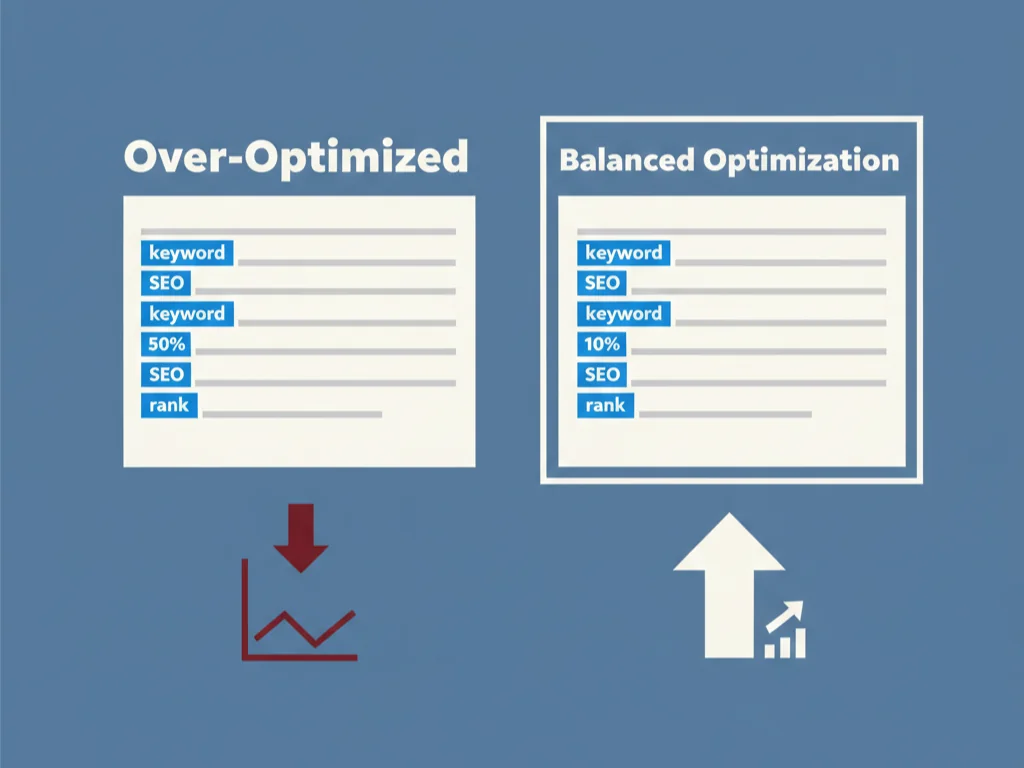
Before we get into the heavy lifting, let’s make sure we’re talking about the same thing.
The Core Formula
At its simplest, keyword density is just a math equation:
$$(Keyword Frequency / Total Word Count) * 100 = Density Percentage$$
Visual Example: If you’re writing about “espresso machines” and you use that exact phrase 10 times in a 1,000-word article, your density is exactly 1%. Simple, right?
The Evolution from 2005 to 2026
Keyword density has gone through a serious glow-up.
- The Stuffing Era: Early 2000s. It was all about quantity. Quality was optional.
- The Panda & Hummingbird Shift: This is when Google started getting smart. It stopped just counting words and started looking at the context around them.
- The Current State: Today, density isn’t a “ranking signal” in the way it used to be. Instead, it’s a Spam Signal. Google uses it to decide if you are trying too hard to manipulate them.
Density vs. Prominence vs. TF-IDF
This is where people usually get tripped up.
- Density: How many times the word appears.
- Prominence: Where it appears. A keyword in your H1 or the first 100 words carries way more weight than one buried in your footer.
- TF-IDF: This stands for Term Frequency-Inverse Document Frequency. It sounds fancy, but it basically measures how unique a word is to your page compared to every other page on the internet. It’s how Google knows a page is truly about “quantum physics” and not just mentioning it in passing.
The “Ideal” Keyword Density Percentage for 2026
I hate to be the bearer of bad news, but there is no “magic number.” If an “expert” tells you that you must hit exactly 1.8%, they are probably trying to sell you a bridge.
Debunking the “2%” Myth
The ideal density changes based on what you are writing. A 2,000-word deep dive into the history of Rome is going to have a much lower density than a 200-word recipe for chocolate chip cookies.
The Safe Zone Guidelines
While there’s no law, here are the patterns I usually see working in the real world:
- Informational Blogs: 0.5% to 1.5% is the sweet spot. It feels natural and keeps the reader engaged.
- E-commerce Product Pages: These can often go higher, maybe 2% to 3%. Since the word count is lower and you’re listing specs, the keyword naturally pops up more.
- The Red Zone: Anything above 3% or 4% is usually where the “over-optimization” alarms start screaming. At that point, your writing probably sounds like a robot had a stroke.
Top Keyword Density Checker Tools (Free & Paid)
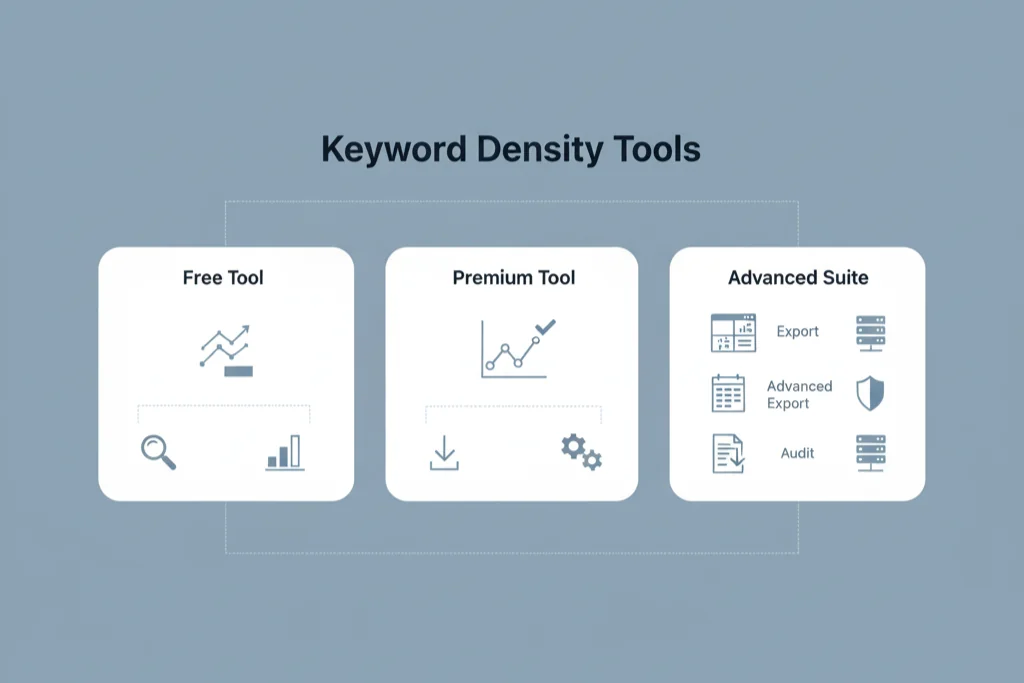
You don’t need to count these by hand. I tried that once for a client project. It was a nightmare, and I missed like half the instances anyway.
Free Browser-Based Tools
- SmallSEOTools: It’s basic, it’s free, and it gets the job done for a quick check.
- PrePostSEO: I like this one because it gives you a “heat map.” It shows you where the clusters are so you can see if you’ve accidentally bunched all your keywords in one paragraph.
- SEO Minion: This is a browser extension that lets you analyze your competitors’ pages on the fly. Super handy when you’re doing “recon.”
Integrated WordPress Plugins
- Yoast SEO: The classic. It uses a traffic light system. It’s great for beginners, though sometimes it’s a bit too rigid for my taste.
- RankMath: I personally prefer this one. Their Content AI doesn’t just look at one word, it looks at the whole “vibe” of the post.
- AIOSEO: Their TruSEO analysis is pretty solid for catching those weird over-optimization issues.
Professional SEO Suites
If you’re serious about this, you’re probably looking at Surfer SEO or Frase. These tools are the gold standard. They don’t just count your main keyword. They tell you which related words (entities) you’re missing. According to a report by Ahrefs, comparing your content against the top 10 ranking rivals is the only way to truly know what density works for a specific search term.
How to Use a Density Checker for Competitive Advantage
Here is how I actually use these tools in my daily workflow. It’s not about hitting a goal, it’s about not being the “weirdo” in the search results.
Step 1: Analyze Your Top 3 Competitors
If the person ranking #1 has a density of 0.7% and you’re sitting at 2.8%, you are an outlier. In the eyes of an algorithm, being an outlier is usually bad. Copy their homework. See how often they use the keyword and, more importantly, where they put it.
Step 2: The “Gap Analysis”
This is the “secret sauce.” Use your tool to find words that are missing. If you’re writing about “Apple” (the tech company) but your checker doesn’t see words like “iPhone,” “Tim Cook,” or “iOS,” Google might think you’re writing about the fruit. These are called LSI Keywords (Latent Semantic Indexing).
Step 3: Cleaning Up “AI Fluff”
Honestly, this part trips people up all the time. AI writers like ChatGPT have a “tell.” They love words like “Furthermore,” “Crucial,” and “In the rapidly evolving landscape.” Run your AI content through a density checker to see if you’ve used the word “leverage” 15 times. It’s a dead giveaway that a human didn’t write it.
Fixing Density Issues: A Tactical Guide
So you ran the check and the results are… well, they’re bad. Don’t panic.
Scenario A: Your Density is Too High
If you’re over 3%, you need to prune. But don’t just delete sentences.
- The Synonym Swap: Instead of saying “Best Coffee Maker” for the tenth time, try “Top Brewing Machine” or “High-End Espresso Device.”
- Pronominal Reference: Use “It,” “This,” or “The product.” Your readers (and Google) are smart enough to know what you’re talking about.
Scenario B: Your Density is Too Low
If you’re under 0.5%, you might be being too subtle.
- Check the Headings: Make sure your keyword is in at least one H2. It’s the easiest way to signal relevance.
- The “Bridge” Method: Add an FAQ section. It’s a natural place to use the keyword in a question. “Is this the best coffee maker for beginners?” See? Totally natural.
Beyond Google: Density on Other Platforms
SEO isn’t just for Google anymore.
- YouTube SEO: The algorithm “listens” to your video. Using your keyword in your spoken script (for those auto-captions) is actually huge.
- Amazon & Etsy: These are “old school” search engines. They actually like a bit more keyword density in the bullet points.
- App Store Optimization (ASO): You have very little space here, so every word counts. Density is actually quite high in successful app descriptions.
The Future: Semantic Search & Entities
We are moving away from “counting strings” to “connecting things.” Google is building a Knowledge Graph.
If you write a page about the “Civil War” but never mention “Abraham Lincoln” or “Gettysburg,” Google is going to be suspicious. It doesn’t matter if your keyword density for “Civil War” is a perfect 1.2%. You’ve missed the entities that define the topic.
Modern NLP (Natural Language Processing) tools now analyze the relationship between words. My previous experience has shown that focusing on “Entity Density” is way more effective than just chasing a single keyword.
Frequently Asked Questions (FAQ)
Does keyword density affect Voice Search?
Indirectly, yes. Voice search prefers natural, conversational language. If your density is too high, your content will sound robotic, and voice assistants probably won’t read it out.
Does Google penalize low keyword density?
Not exactly. You won’t get “penalized,” you’ll just be ignored. If you don’t use the word at all, it’s hard for Google to be sure you’re a match for the search.
Should I count “Stop Words” (and, the, a)?
Most modern checkers ignore these, and you should too. They don’t carry any SEO weight.
How do I check density for Local SEO?
The rules are the same, but you’ll want to include your city or neighborhood as part of your keyword phrase (e.g., “Plumber in Brooklyn”).
Conclusion: The “Natural” Litmus Test
At the end of the day, the best keyword density checker is your own voice. Read your article out loud. If you sound like a broken record or a robot that’s about to short circuit, your density is too high. It doesn’t matter what the tool says.
Use these checkers as a guardrail, not a roadmap. They are there to keep you from driving off the cliff of spam, not to drive the car for you. Focus on answering the user’s intent with depth and empathy, and the keywords will usually take care of themselves.