

For nearly two decades, SEOs have obsessed over a single, magic number.
“Should my keyword density be 2%? Is 5 times too many? Will I get penalized if I hit 10?”
Honestly, it’s exhausting just thinking about it.
In 2026, counting keywords is like trying to calculate the fuel efficiency of a car by counting how many times you press the gas pedal. It measures activity. It doesn’t measure performance.
The game has changed completely. With the rise of Google’s Neural Matching and the dominance of LLM-based search (think SearchGPT and Google’s AI Overviews), the algorithm doesn’t scan for strings of text anymore. It scans for concepts. It looks for relationships.
This guide is going to deprogram you from the “Keyword Density” mindset. We are going to train you on the actual standard that matters right now: Entity Frequency and Semantic Depth.
If you’re still hitting Ctrl+F to count your phrases, you are doing it wrong. Let’s fix that.
The Death of “Keyword Density” (And What Replaced It)
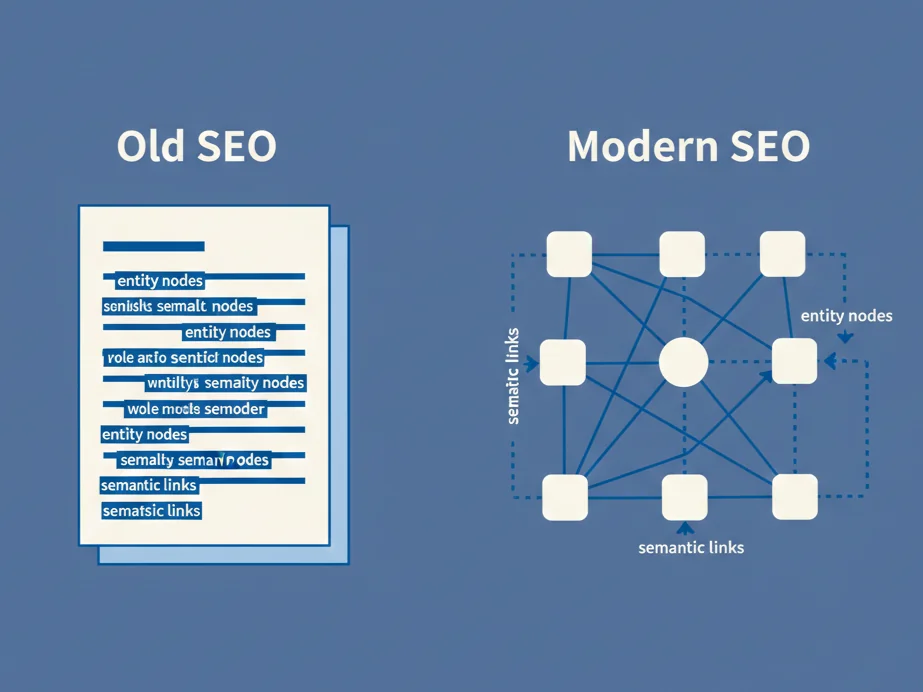
Here is a hard truth. The “1-2% rule” is dead.
You know the one. The old 2015 logic that said you need to mention your target keyword once every 100 words. If you follow that today, you aren’t just wasting time. You are actively hurting your readability.
Worse, you are signaling to AI bots that your content is low-quality fluff.
From Strings to Things
Google’s Knowledge Graph doesn’t read like a human does. It reads like a librarian with a photographic memory.
When you write about “best running shoes,” Google isn’t counting the string of characters b-e-s-t-r-u-n-n-i-n-g-s-h-o-e-s.
It looks for the entity “Running Shoes.”
Then, it looks for connections. It expects to see related nodes like “Marathon,” “Arch Support,” “Durability,” and “EVA Foam.”
If you write “running shoes” 50 times but never mention “arch support,” Google knows your content is shallow. It lacks Information Gain.
The New Metric: Information Gain
Google wants to rank pages that add new data to the conversation. They don’t want pages that just repeat the keyword the most times.
Think about it. If ten articles all say the same thing, why should yours rank #1? Just because you said the keyword 12 times instead of 10? No way.
You rank by covering the topic with more depth than the guy below you.
The “Goldilocks” Zone: How Many Times Should You Actually Use It?
Okay, I know you still want a number. Humans love numbers. It makes us feel safe.
I can’t give you a perfect integer, but I can give you a structure.
The “First 100 Words” Rule
The placement of your first mention matters 10x more than the total count.
If your keyword appears in the first paragraph, you tell both the user and the bot immediately: This is what this page is about.
If you bury it in paragraph four, you’ve probably already lost the user. And if you lose the user, the algorithm notices the bounce rate (or “pogo-sticking”) and drops you like a stone.
The “Spine” Strategy
Don’t worry about scattering keywords like confetti. Worry about the Spine of your article.
Your target keyword (or a very close variant) needs to exist in the structural bones of the page.
Make sure it hits these five spots:
- The H1 (Title): Non-negotiable.
- The URL Slug: Keep it short. /keyword-count-seo/ is better than /how-to-find-the-best-keyword-count-for-your-blog/.
- At least one H2: Usually the first or second subheading.
- The Meta Description: This doesn’t help rankings directly, but it boosts your Click-Through Rate (CTR).
- The Conclusion: Wrap it up nicely.
If you hit these five spots, you have done 80% of the work. The rest is just writing naturally.
Visualizing the Balance:
Imagine a heat map of your article. The top (intro) and the headers should be “hot” with keywords. The body paragraphs should be “cool,” focusing on explanation and storytelling rather than repetition.
Entity Frequency vs. Keyword Stuffing
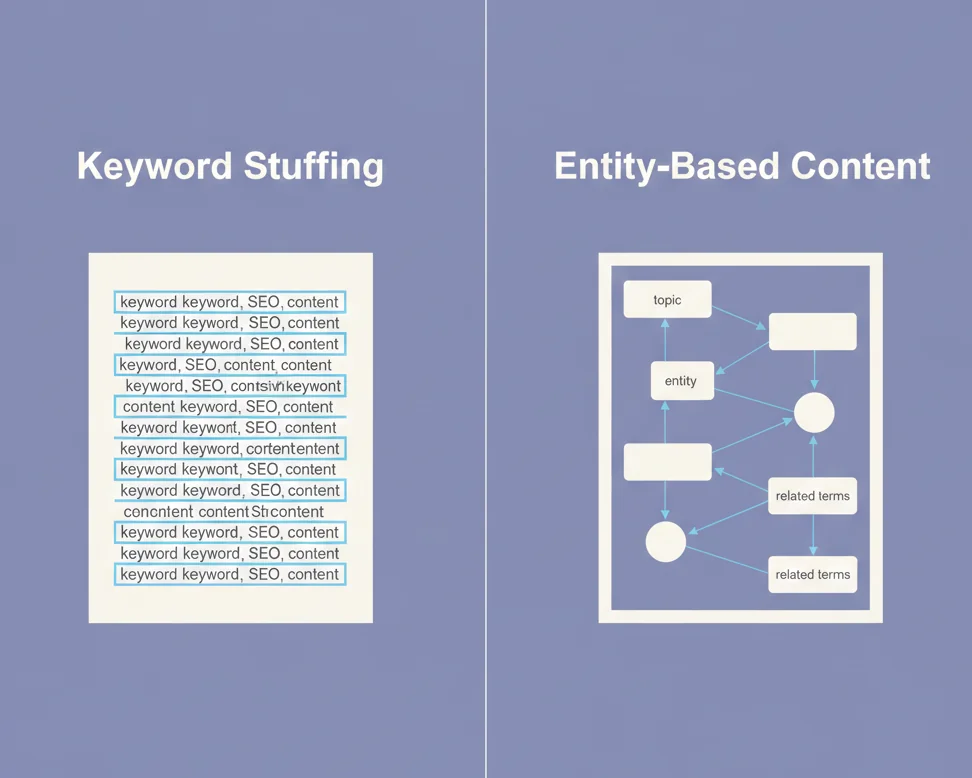
Here is where most people get tripped up.
You might think, “If I don’t repeat the keyword, how does Google know I’m relevant?”
The answer is Entity Frequency.
What is Entity Frequency?
Instead of repeating “SEO Audit” 20 times, you mention the things that make up an SEO audit.
You talk about:
- Technical Crawl
- Backlink Profile
- Core Web Vitals
- Schema Markup
These are related entities. By using them, you prove you know the topic without sounding like a broken record.
TF-IDF in 2026
I’ll keep this simple because the math is boring.
TF-IDF stands for Term Frequency-Inverse Document Frequency. It sounds fancy, but it just means:
- “How often does this word appear on your page?”
- Compared to
- “How often does it appear on the web in general?”
If you use the word “the” a thousand times, nobody cares. It’s common.
But if you use the word “canonical tag” five times, that’s significant. That’s a rare term associated with a specific topic.
You need to find the “missing words” your competitors are using that you aren’t. If the top 10 results all mention “mobile responsiveness” and you don’t, you have a content gap.
The “Salience Score”
Google’s NLP API assigns a Salience Score to entities in your text. It ranges from 0.0 to 1.0.
- 0.0 means the word is irrelevant noise.
- 1.0 means the word is central to the text.
Here’s the kicker. You can have a high keyword count but a low Salience Score if your writing is unfocused. If you ramble about your grandma’s cookie recipe for 500 words before talking about SEO, your salience drops.
Optimizing for AI & “Zero-Click” Searches
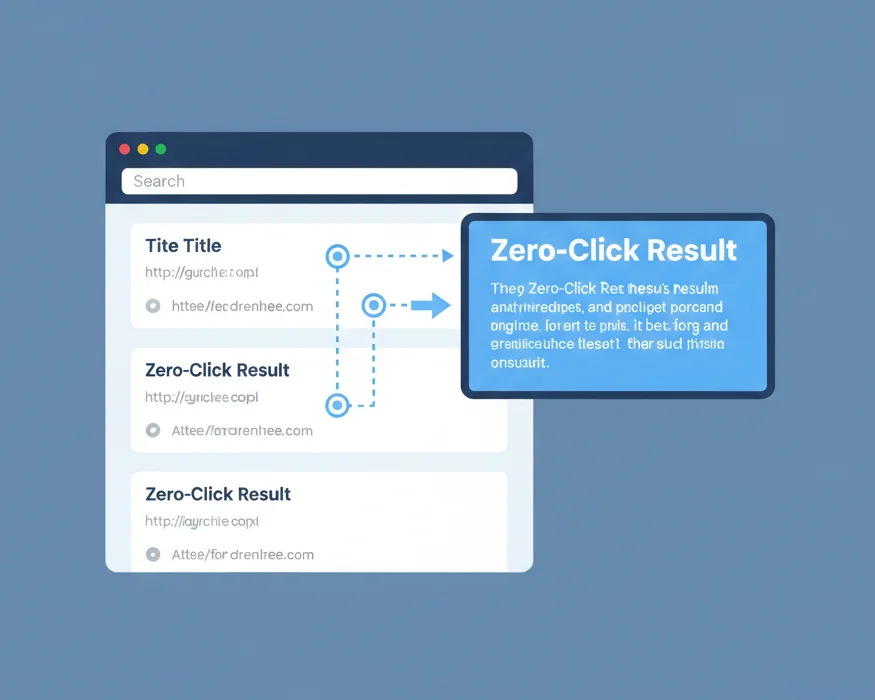
This is the part most people skip. And it’s going to bite them in the rear over the next few years.
AI models like Gemini and ChatGPT are changing how search works. We call this Generative Engine Optimization (GEO).
These models are trained on massive datasets. They know what “spam” looks like. If you repeat a word unnaturally, the model flags it as low-quality input.
The “Answer Key” Format
AI wants clear, structured data.
Using your keyword once in a clear, bolded definition is often worth 50 mentions in a messy wall of text.
Try this format near the top of your post:
[Keyword] is [concise definition] that helps [target audience] achieve [specific outcome].
This is catnip for AI bots. It fits perfectly into their “context window” and increases the chances of you being cited as the source in an AI overview.
Case Study: The “Over-Optimization” Trap
Let’s look at a hypothetical scenario based on stuff I see all the time.
Page A: The Stuffer
- Topic: “Best Coffee Grinder”
- Keyword Count: 35 mentions of “best coffee grinder” in a 1,500-word post.
- Reading Experience: Painful. “Looking for the best coffee grinder? We found the best coffee grinder for you because the best coffee grinder is essential.”
- Result: Stuck on Page 3. Google Panda (and later updates) crushed this style years ago.
Page B: The Semantic Pro
- Topic: “Best Coffee Grinder”
- Keyword Count: 4 exact matches.
- LSI Keywords: Mentions “burr vs blade,” “consistency,” “French press settings,” “ceramic burrs,” “heat generation.”
- Result: Ranks #1.
The “Synonym Swap”
This is my favorite trick.
When you feel the urge to type your keyword again, stop. Find a synonym.
Instead of saying “Digital Marketing Strategy” for the tenth time, try:
- “Online growth plan”
- “Marketing roadmap”
- “Digital outreach”
It sounds more human. It keeps the reader engaged. And interestingly enough, it signals more relevance to the bot because you are covering the semantic field.
Tools to Measure “Semantic Density” (Not Just Counts)
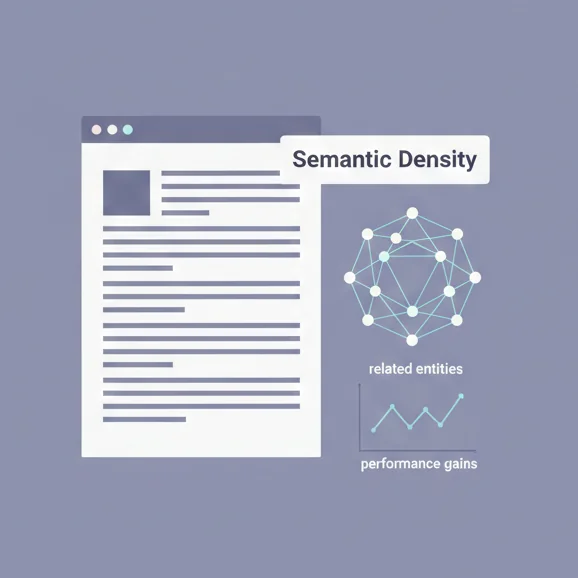
If you are just using Ctrl+F to check your work, you are flying blind.
Here is the tool stack I’d look at for 2026.
1. Surfer SEO or Frase
These tools don’t just count words. They analyze the top 20 results and tell you which entities you are missing. They essentially automate the TF-IDF analysis for you.
2. Google’s Natural Language API Demo
This is a free little hack. You can copy-paste your text into Google’s official API demo. It will show you exactly how Google categorizes your content and what the Salience Score is for your main entities.
3. ChatGPT (Your Editor)
I use this one daily. After I write a draft, I paste it into ChatGPT and ask:
“Analyze this text for keyword stuffing. Does it sound robotic? Suggest 3 semantic variations for the term ‘link building’.”
It’s surprisingly good at catching those awkward phrases we become blind to after staring at a screen for four hours.
Checklist: Your “Keyword Balance” Workflow
You don’t need a complex spreadsheet. You just need a sanity check.
Before you hit publish, run through this:
- Map the Intent: Are they looking for a definition (What is X?) or a product (Buy X)? Match that first.
- Place the “Spine”: Is the keyword in the URL, H1, and Intro? Good.
- Draft with Entities: Did you cover the sub-topics (the “missing words”)?
- Audit the “Fluff”: Search for your keyword. If you see it three times in one paragraph, delete two of them.
- The “Read Aloud” Test: This is the ultimate filter. Read your intro out loud. If you stumble or feel silly saying a sentence because it sounds repetitive, change it. If it sounds weird to say, it reads weird to the user.
Conclusion: Write for the User, Structure for the Bot
Here is the bottom line.
The perfect keyword count is as many times as necessary to be clear, and not one time more.
I know that’s not the specific number you wanted when you clicked this article. But it is the truth.
As search moves toward Voice and Visual modalities, exact text matches matter less and less. The algorithm is getting scarily good at understanding intent.
So, stop counting. Start answering.
If you write the most helpful, comprehensive guide on the internet, the keywords usually take care of themselves.
Now, go check that draft you’ve been working on, I bet you can delete at least five instances of your main keyword without anyone noticing.